
Buying guides
Biofeedback for anxiety: which devices actually work in 2026 (an honest review)
Honest 2026 guide to biofeedback devices for anxiety — HeartMath, Muse 2, Pulsetto, Sensate, Apollo Neuro. Real evidence, real prices, Woo-Woo Meter ratings.
“Coherence training via biofeedback is one of the older, better-validated forms of consumer-accessible nervous system regulation.”
A therapist mentioned biofeedback. A Huberman episode mentioned HRV. Your group chat is split between the people swearing by Pulsetto and the people swearing by Sensate. You're sitting at $150 to $300 of disposable income and a baseline of low-grade anxiety, trying to figure out whether any of this is real.
This is the honest map. Biofeedback for anxiety is real — but most of the devices marketed under that banner aren't biofeedback in the strict sense. The category sprawls across HRV training, EEG-feedback meditation, vagus nerve stimulation, and vibroacoustic relaxation, and a buyer's experience depends almost entirely on which of those they end up with. Below is what the literature actually says, which device fits which buyer, and what to ignore.
What biofeedback actually is (and isn't)
Biofeedback, in the technical sense, is a closed loop: a sensor measures something your body is doing — heart rate variability, brainwave patterns, skin conductance, breathing rate — and feeds that signal back to you in real time so you can learn to influence it. The "feedback" part is non-negotiable. A device that buzzes on your chest without measuring anything is not biofeedback. It's a vibration toy with a wellness logo.
This distinction matters because the marketing has flattened it. Vagus nerve stimulators (Pulsetto, Truvaga) deliver a current — they don't measure or feed back. Vibroacoustic devices (Sensate, Apollo Neuro) deliver vibration — same thing. They're all sold next to true biofeedback hardware and they all rank for "biofeedback for anxiety," but mechanistically they're a different category. We'll cover both, but we'll keep the labels honest.
Does biofeedback work for anxiety? What the evidence says
"Coherence training via biofeedback is one of the older, better-validated forms of consumer-accessible nervous system regulation."
The cleanest evidence base sits under HRV biofeedback. Shaffer & Ginsberg's 2017 overview in Frontiers in Public Health is the standard reference for HRV as a validated biomarker of autonomic balance. Resonance-frequency breathing — the technique HRV biofeedback trains you in — has its own independent literature: dozens of small RCTs spanning generalized anxiety, hypertension, asthma, and PTSD symptoms. Effect sizes are modest but consistent, and the durable benefit (a learned breathing skill that transfers off the device) is the strongest thing in the entire consumer wellness aisle.
The HeartMath research library catalogues hundreds of papers on coherence training specifically — useful, with the honest caveat that a large share are institutional, single-arm, or measure short-term coherence rather than durable clinical endpoints. The mechanism is well-validated; the bigger "heart-brain coherence" framing the company markets goes further than what's been published.
EEG-feedback meditation (Muse) has a smaller but real published base. Muse's clinical library lists multiple studies, mostly small and several with sponsorship ties — useful directional evidence, not independent validation. The honest read: Muse helps people learn what a quieted mind feels like in the moment. It's onboarding to mindfulness, not a standalone anxiety treatment.
Vagus nerve stimulation sits at a different evidence tier. Yap et al.'s 2020 review in Frontiers in Neuroscience catalogues the tVNS-for-anxiety literature: promising small trials, plausible mechanism, no large sham-controlled study that would justify selling the devices as anxiety treatment. The current FDA tVNS clearances are narrow — none of them clear consumer vagus devices as anxiety treatments. They're sold as wellness products.
Vibroacoustic relaxation (Sensate, Apollo) has the thinnest published base of the group. Plausible mechanism — slow vibration in the sub-audible range may engage parasympathetic pathways — but the trial evidence is mostly company-sponsored and small. The experiential payoff is real; the clinical claims should not be.
The five flavors of "biofeedback for anxiety" you'll see sold
1. HRV coherence training — A pulse sensor plus an app that visualizes your HRV in real time as you breathe at roughly 0.1 Hz (six breaths per minute). True closed-loop biofeedback. The category leader is HeartMath Inner Balance. Woo-Woo Meter: 2/5 — real mechanism, real evidence, dated UX, marketing that occasionally drifts past the data.
2. EEG-feedback meditation — A headband measures brainwaves and translates them into audio (a calm beach when you're focused, a stormy one when your mind wanders). Muse 2 and Muse S own this lane; Flowtime is the credible alternative. Woo-Woo Meter: 2/5 — the signal is real, the trials are small, the experience is genuinely instructive.
3. Vagus nerve stimulation — A device clips to your neck and delivers a transcutaneous current to a branch of the vagus nerve. Not biofeedback — it's stimulation, with no measurement loop. Pulsetto and Truvaga are the consumer options. Woo-Woo Meter: 3/5 — plausible mechanism, immature evidence, FDA cleared as wellness only.
4. Vibroacoustic / vibrotactile relaxation — A device delivers slow vibration to your chest (Sensate) or wrist/ankle (Apollo Neuro). Also not biofeedback — there's no measurement of your physiology, only delivery of a stimulus. Woo-Woo Meter: 3/5 — the most pleasant of the group, the thinnest evidence, the easiest to stick with.
5. Multi-sensor home biofeedback units — A generic clip that measures HRV and sometimes GSR (skin conductance) for general nervous-system training. Home biofeedback training devices at the budget end vary wildly in quality. Woo-Woo Meter: 3/5 — the mechanism is real, the consumer-grade hardware quality is the wildcard.
For the rubric behind these ratings, see what is the Woo-Woo Meter.
Best for HRV coherence training: HeartMath Inner Balance
The HeartMath Inner Balance sensor (~$180) is the category's longest-running clinical case. A small Bluetooth ear or fingertip clip pairs with HeartMath's app; you breathe at a paced rhythm and watch your HRV trace push into the green "coherence" zone in real time. Sessions run 5–15 minutes.
The published research base is unusually deep — older and broader than nearly any other consumer wellness device. The hardware works reliably. The app, however, looks like an iPad app from 2014 and the visualizations haven't been redesigned in years. None of that breaks the mechanism; it just kills adherence for users who bounce off dated UX.
Buy this if you want to train a skill. After a few weeks of daily sessions, most users can drop into resonance-frequency breathing without the sensor. The device is training wheels for a practice. Our full HeartMath Inner Balance honest review covers the longer take.
Best for EEG-style meditation feedback: Muse 2
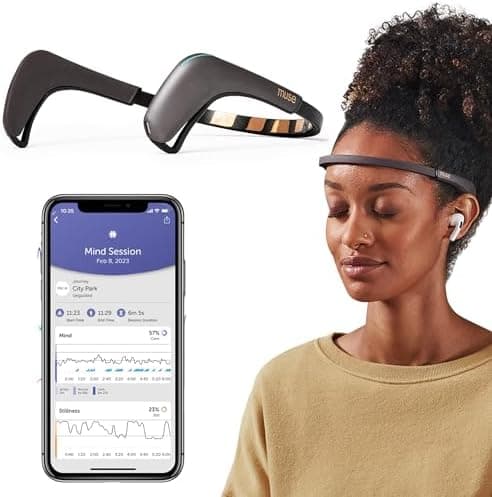
The Muse 2 headband (~$250) measures EEG, heart rate, breathing, and body movement, and translates your brain state into adaptive audio during meditation. When your mind drifts, the soundscape gets stormy; when you settle, it goes quiet. Most users describe it as the first time they could see what mind-wandering feels like in real time.
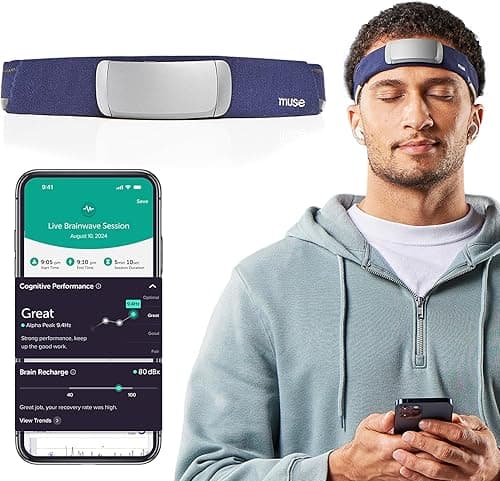
That's the honest sell: Muse is a meditation onboarding device, not an anxiety treatment. The trials are small and several are sponsored. For learning to notice your nervous system mid-session, it works well. For chronic anxiety, the evidence isn't there. The Muse S Gen 2 is the same signal in a softer form factor that doubles as a sleep headband — our Muse 2 vs. Muse S comparison covers which one to buy.
Best vagus nerve / "biofeedback-adjacent" pick: Pulsetto
Pulsetto (~$269) is not biofeedback. It's transcutaneous vagus nerve stimulation — a current delivered to the neck via two electrodes, with no measurement loop. We're including it because it dominates every "biofeedback for anxiety" search and because the underlying mechanism is the most direct intervention on the parasympathetic pathway in the consumer aisle.
The Yap 2020 review covers the small-trial evidence honestly: promising, immature, in need of larger sham-controlled work. FDA clearance is wellness-only, not anxiety treatment. Our Pulsetto honest review and the vagus nerve devices evidence breakdown cover the details. Truvaga is the more clinically-styled alternative at a higher price point — see our best vagus nerve devices 2026 roundup for the head-to-head.
Best for "I just want to feel calmer in 10 minutes": Sensate 2 or Apollo Neuro
Sensate 2 ($300) delivers sub-audible bone-conduction vibration through a stone you place on your sternum, paired with a soundscape app. Apollo Neuro ($350) delivers patterned vibration to your wrist or ankle, designed to be worn through the day.
Neither is biofeedback — but both are pleasant, low-friction, and demonstrably effective at short-term subjective calm. The published evidence base is small and mostly sponsor-adjacent. The user-reported adherence is among the highest in the category because you don't have to learn anything; you just turn it on. Treat them as somatic-calm tools rather than anxiety treatments. Our Pulsetto vs. Sensate breakdown and Apollo Neuro honest review get into the trade-offs.
Best budget pick: a generic home biofeedback unit
Cheap, multi-sensor home biofeedback training devices measure HRV and sometimes skin conductance for general nervous-system training. The mechanism is identical to HeartMath's; the build quality, signal stability, and app polish are not. Caveat heavily — at this price tier, half the listings on Amazon are rebranded clones of the same unbranded module, and the apps are inconsistent.
If you're price-sensitive and willing to tolerate rough edges, this is the cheapest path to a true biofeedback loop. If you can stretch to $180, HeartMath is the better buy.
What we'd actually buy, by buyer profile
- The data nerd — someone who wants to see a number go up: HeartMath Inner Balance. Real metric, real practice, real durable skill. Pair with a Polar H10 chest strap if you want reference-grade HRV trend data outside training sessions.
- The would-be meditator — someone who has bounced off Headspace three times: Muse 2. The audio feedback is the cue that breaks the staring-at-a-timer trap most beginners get stuck in.
- The just-make-me-feel-better buyer — someone with chronic baseline anxiety who wants the lowest-friction, highest-pleasantness option: Sensate 2 for sit-down sessions, Apollo Neuro for all-day wear. Be honest with yourself that these are calm-cues, not treatments.
If you want one device and have $200–$300 to spend, HeartMath is our default recommendation. Cheapest path from "wants a device" to "has a practice the literature supports." Add Pulsetto on top if chronic baseline anxiety is the problem and you want a more direct vagal intervention.
Things to ignore
- Anything sold as "biofeedback" that doesn't measure something specific and feed it back to you in real time. A passive light mask is not biofeedback. A singing bowl is not "neuro-biofeedback."
- Apps that estimate your "stress level" from phone gyroscope data and call themselves biofeedback. They aren't.
- Marketing that promises specific anxiety symptom reduction from a wellness-cleared device. The FDA clearance status of every consumer vagus and vibroacoustic device on this list is wellness, not anxiety treatment.
- Stacking five devices. If you can't get a daily 10-minute practice with one, you won't with five.
The honest take: biofeedback for anxiety is one of the few corners of consumer wellness tech where the underlying science is real, the mechanism is well-defined, and the durable benefit (a learned breathing or attention skill) outlives the device. The trap is buying a vibration toy and calling it biofeedback. Buy a device that measures something and feeds it back to you, commit to four weeks of near-daily sessions, and the practice is what you keep.
Products mentioned in this post
HeartMath Inner Balance Sensor
HeartMath's HRV biofeedback sensor for coherence and resilience training.
Muse 2 Brain Sensing Headband
Seven-sensor EEG headband with real-time feedback to keep your meditation honest.
Muse S Gen 2 Headband
Soft fabric EEG headband for both meditation and overnight sleep tracking.
Pulsetto Vagus Nerve Stimulator
App-controlled non-invasive vagus nerve stimulator for stress, sleep, and anxiety.
Truvaga Vagus Nerve Stimulator
Handheld clinical-grade vagus nerve stimulator — quick daily sessions.
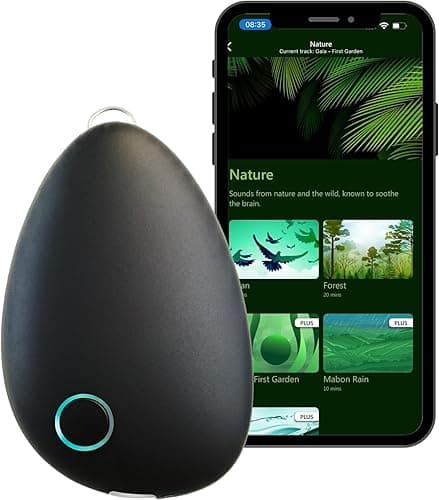
Sensate 2 Relaxation Device
Vagus nerve relaxation device using infrasound vibration for stress and anxiety relief.
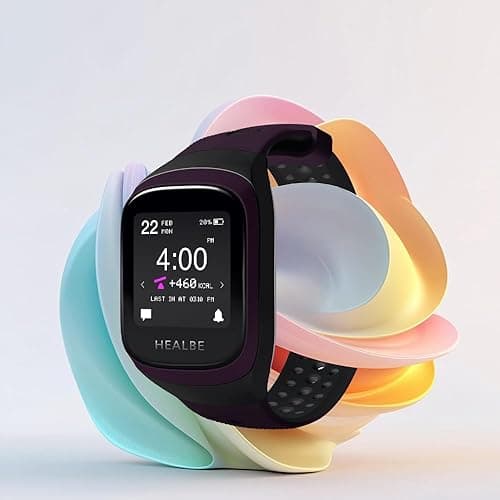
Apollo Neuro Wearable
Vibration-based wearable for stress relief and sleep, with growing clinical evidence.
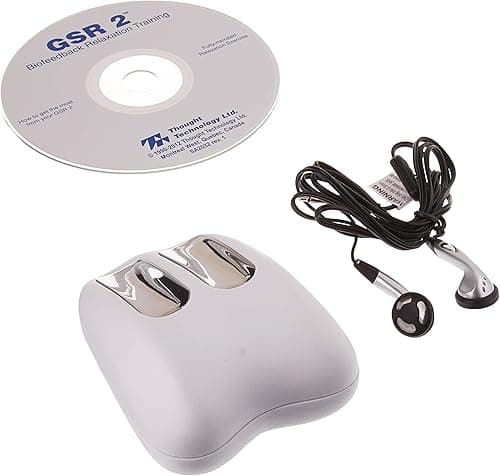
Biofeedback Home Training Device
Home biofeedback training system for stress management and self-regulation.
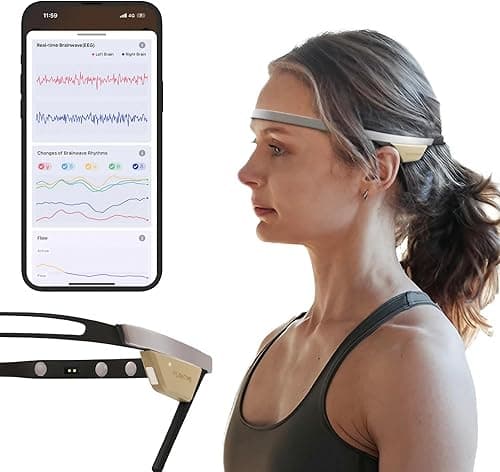
Flowtime Biosensing Meditation Headband
Budget biosensing headband — EEG plus HRV training without the Muse premium.
Polar H10 Heart Rate Sensor
The gold-standard chest strap for HRV and heart rate — ANT+ and Bluetooth in one.
Frequently asked
- Is biofeedback the same as neurofeedback?
- Neurofeedback is a sub-type of biofeedback that uses brainwave activity (EEG) as the measured signal. Biofeedback is the broader category — it includes neurofeedback but also HRV biofeedback, breathing biofeedback, skin conductance (GSR) biofeedback, and muscle (EMG) biofeedback. Consumer devices like Muse 2 are EEG-based, which makes them a form of neurofeedback. HeartMath Inner Balance is HRV biofeedback. Both are biofeedback in the broader sense.
- Does insurance cover biofeedback devices for anxiety?
- Almost never for consumer hardware. Insurance sometimes covers clinical biofeedback sessions with a licensed therapist when billed under specific CPT codes for diagnosed conditions, but the consumer devices in this guide are sold as wellness products and aren't reimbursable. A few HSA/FSA platforms will accept HeartMath Inner Balance or similar with a letter of medical necessity from a clinician — worth asking, but not a path to count on.
- Can I do biofeedback with just my Apple Watch or Oura Ring?
- Partially. Apple Watch and Oura both track HRV trends overnight, which gives you a lagging biomarker of autonomic balance — useful, but not the same as in-session biofeedback. Neither device shows your HRV pushing into resonance as you breathe in real time, which is the core training loop that makes biofeedback effective. If you pair an Oura or Apple Watch with a free paced-breathing app, you'll get most of the durable benefit of biofeedback (the learned breathing skill) without the real-time loop. See our Oura vs. Apple Watch for sleep comparison for HRV-tracking detail.
- How long until I notice anything from a biofeedback device?
- Acute effects are immediate — most users feel calmer after a single 5–15 minute HRV coherence or Muse session. Skill acquisition (being able to hit coherence or a quiet meditation state on demand) usually takes 2–3 sessions. Durable changes in baseline HRV, stress reactivity, or anxiety symptoms take 4–8 weeks of near-daily practice and are heavily confounded by sleep, exercise, and alcohol. The most reliable durable benefit is the learned skill itself, which transfers off the device.
- Is Pulsetto or Sensate actually biofeedback?
- Neither, strictly. Pulsetto is transcutaneous vagus nerve stimulation — it delivers a current without measuring anything. Sensate is vibroacoustic relaxation — it delivers vibration without measuring anything. Both are sold in the same shopping aisle as biofeedback devices and both show up in 'biofeedback for anxiety' searches, but mechanistically they're stimulation tools, not feedback loops. They may still be useful (especially Sensate for short-term calm and Pulsetto for vagal tone), but they're a different category from true HRV or EEG biofeedback.
Sources
- [1]An Overview of Heart Rate Variability Metrics and Norms · Frontiers in Public Health · 2017-09-28
- [2]HeartMath Research Library · HeartMath Institute · 2026-01-01unverified
- [3]Muse Research Page · InteraXon / Muse · 2026-01-01unverified
- [4]Critical Review of Transcutaneous Vagus Nerve Stimulation: Challenges for Translation to Clinical Practice · Frontiers in Neuroscience · 2020-04-28
- [5]510(k) Premarket Notification — Non-invasive Vagus Nerve Stimulator · U.S. Food and Drug Administration · 2017-04-18unverified
- [6]Oura Research Library · Oura · 2026-01-01unverified
Related reading
More from the desk
Category deep-dives
Pulsetto review: is the breakout vagus nerve device worth $270?
Pulsetto became the most-searched vagus nerve device in 2025. Here's our straight-talk review — what it is, what the evidence says, and whether it earns its price.
Category deep-dives
Vagus nerve devices: what the evidence actually says
Non-invasive vagus nerve stimulation went from obscure neurology to consumer wellness in 18 months. Here's our honest read on the evidence — and what to make of the consumer devices selling it.
Buying guides
Pulsetto vs Truvaga: which vagus nerve stimulator actually delivers in 2026 (honest comparison)
Pulsetto and Truvaga both cost $250–$270 and target the same vagus nerve. Here's the honest head-to-head — app vs. clinical lineage, who should buy which.