Buying guides
Best Tuning Forks for Sound Healing in 2026: An Honest Buyer's Guide
An honest buyer's guide to tuning forks for sound healing — weighted vs. unweighted, the Solfeggio question answered, and three home picks under $50.
“A well-tuned crystal singing bowl is a beautifully made instrument with a real and consistent psychoacoustic effect on practitioners. That's a different kind of useful than a randomized controlled trial — and it's still useful.”
A tuning fork is a two-pronged piece of steel that, when struck, vibrates at a precise frequency for thirty to sixty seconds. That's it. That's the whole instrument. Held near the ear or pressed against the body, it produces a clean tone and a tactile hum that practitioners use as an anchor for meditation and bodywork. For under $50 you can own a beautifully made one, which is part of why this category quietly outlives every wellness gadget trend.
This guide is for the person who already knows they want one — meditators building a home sound-healing kit, bodyworkers buying a first set, anyone who's lain on a mat in a sound bath and thought I want to bring this home for less than a flight. We rate the whole tuning-fork category a 5 on our Woo-Woo Meter, and we mean it as a compliment. Here's how to pick one without getting sold a DNA-repair fairytale.
What a Tuning Fork Actually Does
A struck fork vibrates at a labeled frequency — 528 Hz, 432 Hz, 174 Hz, whatever the engraving says. That part is real and measurable. What follows from that strike is a clean, sustained tone, a tactile buzz if you place the stem against bone, and an attentional anchor that helps a practitioner sit still and focus.
Stop there. Don't claim it tunes your cells. Don't claim it repairs DNA. The honest case for a tuning fork is the same case you'd make for a singing bowl, a candle flame, or a slow breath count: it's a focal object that helps a meditative practice stick. That's enough. A daily ten-minute fork session that gets you to actually breathe is worth more than a $400 device you stop using in three weeks.
"A well-tuned crystal singing bowl is a beautifully made instrument with a real and consistent psychoacoustic effect on practitioners. That's a different kind of useful than a randomized controlled trial — and it's still useful."
The same sentence applies to a tuning fork. We rate it on craft and consistency, not on RCTs.
Weighted vs. Unweighted: The One Decision That Matters
Almost every other choice — Solfeggio set, chakra set, single fork — flows from this one. The two types feel completely different in the hand and on the body.
Unweighted forks are the slim, classic-looking ones. They produce a louder, more piercing tone in the air and are designed to be held a few inches from the ear or used over the body without contact. Sound healers use them for ambient and over-aura work. The tone projects; the tactile buzz is minimal.
Weighted forks have small metal pucks attached to the ends of the prongs. The added mass makes the tone quieter in the air but gives the fork a much stronger physical vibration when the stem is placed on the body — the breastbone, the back of a hand, the side of a knee. This is the bone-conduction sensation people associate with "tuning fork therapy." Most beginners feel weighted forks more directly than unweighted.
Short version. Unweighted = sound in the room, around the head. Weighted = vibration on the body. Most home practitioners eventually want one of each, but you don't need a 7-piece weighted set on day one. A single 528 Hz unweighted fork is a perfectly honest entry point.
The Solfeggio Question, Answered Honestly
Almost every tuning fork on Amazon is sold inside a Solfeggio frame: 174, 285, 396, 417, 528, 639, 741, 852, and 963 Hz, with each frequency assigned a chakra, an emotion, or a "healing" property. Buyers ask whether the framework is real. Here is the honest answer.
The Solfeggio frequency set, as marketed today, is a 20th-century reconstruction. It's loosely inspired by a medieval hexachord but the specific Hz values were popularised in the 1970s. The numbers are arbitrary in the strict acoustic sense — there's nothing physically special about 528 Hz versus, say, 530 Hz. The "528 Hz repairs DNA" claim has no peer-reviewed support and you should ignore it.
That said, the practice of cycling through the nine Solfeggio frequencies as a meditation structure is a coherent, repeatable ritual. Sitting with one tone for ninety seconds, then the next, anchors attention exactly the way mantra repetition or breath counting does. The framework is mythology. The structured practice it produces is still useful. Both can be true.
How to Pick a Fork That Actually Sounds Good
A few details separate a fork that sings for forty seconds from a fork that dies in five:
- Material. Aluminum alloy is the standard. It holds tone well and resists corrosion. Cheap stainless or zinc-blend forks ring briefly and feel dead.
- Striker. A rubber-tipped striker gives you a clean strike on unweighted forks. Weighted forks usually want a felt or weighted mallet to bring out the deeper tone. Most reputable sets include the right striker — if a listing doesn't picture one, skip it.
- Engraving. The frequency should be engraved or stamped on the fork itself, not just printed on the box. Printed labels rub off and leave you guessing what you own.
- Tone test. If the listing or any review includes an audio sample, listen. A good fork sustains for at least 30 seconds and produces a single clean pitch with no metallic clatter.
- Set size. A 7-piece chakra set is overkill if you're not already doing chakra work. A single fork plus a striker is the right starting position for almost everyone.
Pricing and availability move around — current pricing on the SKUs below is tracked via current Amazon listings.
Our Picks for 2026
Three picks, no padding. Two forks and one bowl, because the realistic buyer is building a small kit, not a fork wall.
Best for Beginners: 528 Hz Tuning Fork (Solfeggio)
Woo-Woo Meter: 5 • ~$25
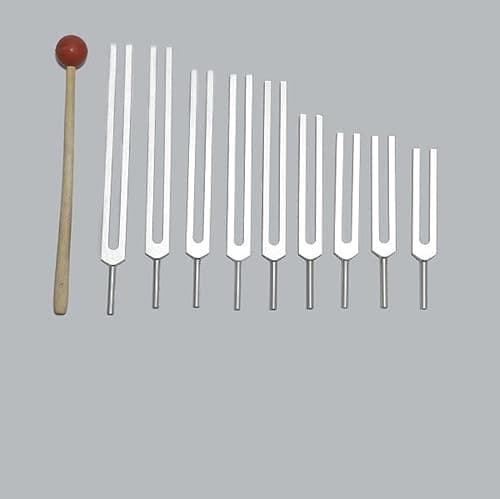
The cheapest honest entry point into the practice. The 528Hz Tuning Fork Set (Solfeggio) is a single unweighted fork engraved at 528 Hz, packaged with a striker. It rings cleanly for 30 to 60 seconds, fits in a backpack, and lets you find out within a week whether daily fork practice is going to stick for you. The 528 Hz framing is spiritual, not acoustic. We name that openly. If the Solfeggio tradition speaks to you, this is your fork. If not, the tone is still beautiful and the price is still $25.
Best Full Kit: Solfeggio 7-Piece Set
Woo-Woo Meter: 5 • ~$45
For the buyer who already knows they want the full Solfeggio cycle. The Solfeggio Tuning Fork Set (7-piece) gives you one fork per traditional chakra frequency in the standard nine-tone tradition, with a striker and a storage case. This is the right pick if you've already done a fork session, you know you'll do one daily, and you want to cycle through the chakras as your practice. If "cycle through the chakras" sounds like a foreign language, buy the single 528 Hz fork instead and revisit this one in six months.
Best Companion (Not a Fork): Tibetan Singing Bowl
Woo-Woo Meter: 5 • ~$35
If you're building a sound-healing corner, not just a fork drawer, the Tibetan Singing Bowl Set (5.5") is the natural pairing. Bronze, hand-hammered, 5.5 inches across, with warm overtones a fork can't produce. Forks give you a single clean pitch; a bowl gives you a layered drone. They sit together in a practice the way a bell and a chime do. A 432 Hz Crystal Singing Bowl works the same role at a louder, more room-filling volume, if that's the direction you're heading. For deeper context on the bowl side of the kit, our singing bowls buyer's guide and crystal vs. Tibetan head-to-head are the sister posts to this one.
A small ritual add-on for kit-builders and gift-givers: a Chakra Stones Healing Crystals Set at around $15 sits well alongside fork work. Optional, not required.
How to Use a Tuning Fork Without Faking It
The technique is simple, which is the point. A practical ten-minute self-session:
- Strike clean. Hold the fork by the stem (never the prongs). Tap one prong firmly against the rubber striker or against the fleshy edge of your palm. Don't bash it on a table — that flattens the tone and dings the metal.
- Unweighted, near the ear. Bring the vibrating prongs slowly toward one ear from about a foot away, then around the head. Listen for the tone settling. Repeat on the other side. Three or four cycles per ear is plenty.
- Weighted, on the body. After striking, place the flat stem (not the prongs) gently on the breastbone, the top of a hand, or the side of a knee. The buzz transmits through bone. Hold for the full sustain — usually 20 to 40 seconds — then re-strike.
- Build a session. Three forks across ten minutes is a full beginner session. Sit, eyes closed, strike, listen, breathe, restrike when the tone fades. That's it. There's no advanced technique waiting later.
If you want a quick rule that filters out 90% of bad sound-healing content: any source telling you to point a fork at a tumor is selling you something, and you should leave.
What We Won't Claim
Be direct about this: peer-reviewed evidence for tuning-fork therapy as a clinical intervention is thin. There are small pilot studies on vibration and pain perception, and an even smaller literature on bone-conduction tone and relaxation, but none of it constitutes a clinical evidence base for the claims you'll see on most fork-selling websites.
So we don't claim it. No DNA repair. No cellular tuning. No cancer treatment. No chakra rebalancing as a physical event. A fork is a struck piece of metal that produces a clean tone and a focused tactile buzz. The case for owning one is the same case you'd make for any beautifully crafted meditation object: it makes the practice stickier. That's the entire honest pitch, and it's enough to justify a $25 purchase.
The Honest Take
Tuning forks are one of the cheapest, most durable entry points into a sound-healing practice. Buy the 528Hz Tuning Fork Set (Solfeggio) for $25 to find out whether you'll actually use it. If, after a month of daily ten-minute sessions, the practice has stuck — graduate to the Solfeggio 7-piece set and start cycling the full chakra series. If you're building a wider kit, pair the fork with a Tibetan Singing Bowl and you have a complete home sound-healing setup for under $80.
What a fork isn't: a medical device. The instrument is honest about what it is — a struck steel rod with a clean tone and a real, repeatable focusing effect. The Woo-Woo 5 isn't us calling the practice silly. It's us refusing to sell it as medicine.
Products mentioned in this post
528Hz Tuning Fork Set (Solfeggio)
Solfeggio 528Hz tuning fork — used in chakra and frequency healing practice.
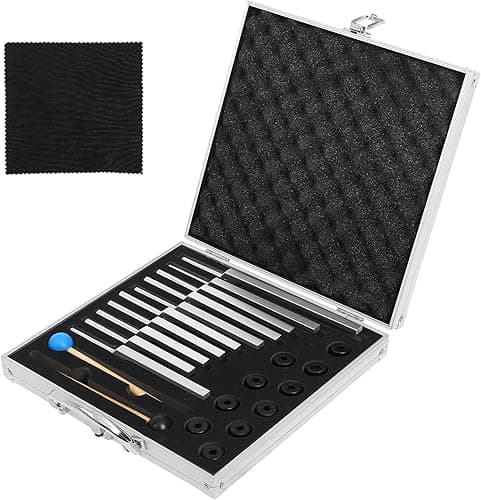
Solfeggio Tuning Fork Set (7-piece)
Full seven-piece Solfeggio tuning fork set for practitioners and home practice.
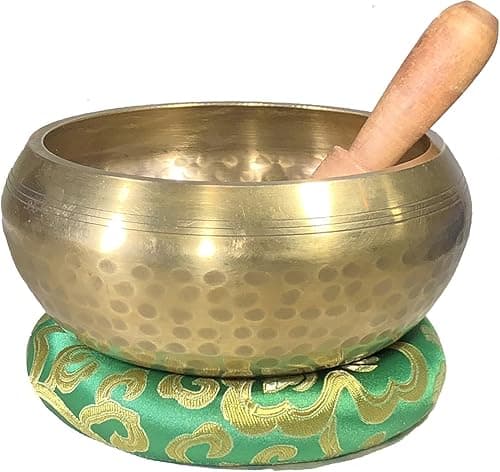
Tibetan Singing Bowl Set (5.5")
Hand-tuned Tibetan singing bowl set for meditation and sound healing.
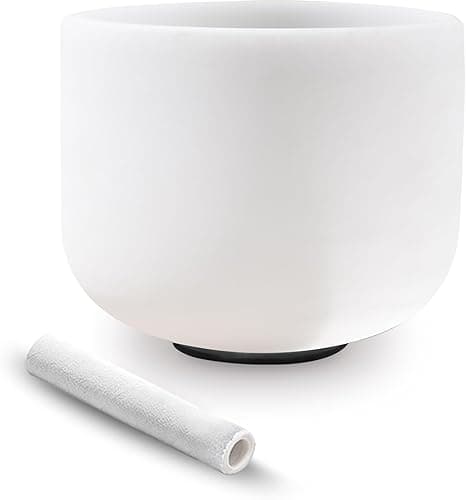
Crystal Singing Bowl 8" (432Hz)
Quartz crystal singing bowl tuned to 432Hz for chakra alignment and sound bath work.
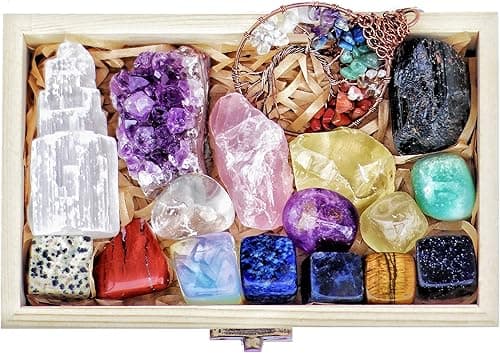
Chakra Stones Healing Crystals Set
Seven-stone chakra healing crystal set — an entry-level spiritual wellness kit.
Frequently asked
- Are tuning forks for sound healing actually worth it?
- If you already meditate or do bodywork, yes — a $25 fork is one of the cheapest meditation tools you'll ever buy, it's effectively indestructible, and it gives you a clean tone and tactile buzz that anchor a practice. If you're hoping a fork will treat a medical condition, no — the clinical evidence base is thin and we don't recommend buying one on that basis.
- Weighted vs. unweighted tuning forks — which should a beginner buy?
- Unweighted for sound work in the air around the head and body; weighted for direct vibration when the stem is placed on the breastbone or another bony point. Most beginners start with a single unweighted 528 Hz fork because it's cheaper and the projecting tone is more obviously satisfying. Add a weighted fork later if you want to feel the buzz through bone.
- What frequency tuning fork should a beginner buy?
- Start with a single 528 Hz fork from the Solfeggio set. It's the most popular standalone frequency, the easiest to find, and the cheapest way to test whether daily fork practice is going to stick for you. The specific Hz isn't acoustically magic — pick the frequency whose tradition speaks to you, or default to 528 Hz if you have no preference.
- Do Solfeggio frequencies actually heal the body?
- No, not in any clinical sense. The 174/285/396/417/528/639/741/852/963 Hz Solfeggio framework is a 20th-century construction, not ancient acoustic science, and claims like '528 Hz repairs DNA' have no peer-reviewed support. The Solfeggio frequencies are still useful as a meditation structure — cycling through them anchors attention the way mantra repetition does — but that's a contemplative benefit, not a physical one.
- Can you use a tuning fork on yourself?
- Yes, easily. Strike the fork against a rubber striker or the edge of your palm, then either hold it near one ear (unweighted) or place the flat stem on your breastbone, hand, or knee (weighted). Hold for the 20–40 second sustain, restrike, repeat. There's no specialist technique gating the practice — sitting still and listening is the whole skill.
Sources
- [1]Amazon product listings (current pricing) · Amazon.com · 2026-04-09
Related reading
More from the desk
Buying guides
Solfeggio Frequencies for Meditation: An Honest Review of the Tones, the Tradition, and the Tools Worth Buying
An honest look at the Solfeggio frequency tradition, what the science actually shows, and which tuning forks and bowls are worth owning for daily practice.
Buying guides
Crystal Singing Bowl vs. Tibetan Singing Bowl: An Honest Head-to-Head for Home Meditation
Crystal vs. Tibetan singing bowl, picked honestly: which to buy first for home meditation, what each one sounds like, and the chakra claims to ignore.
Buying guides
Best Singing Bowls for Meditation in 2026: An Honest Buyer's Guide
An honest buyer's guide to singing bowls for meditation — Tibetan vs. crystal, what to look for, and why we rate the whole category a Woo-Woo 5.